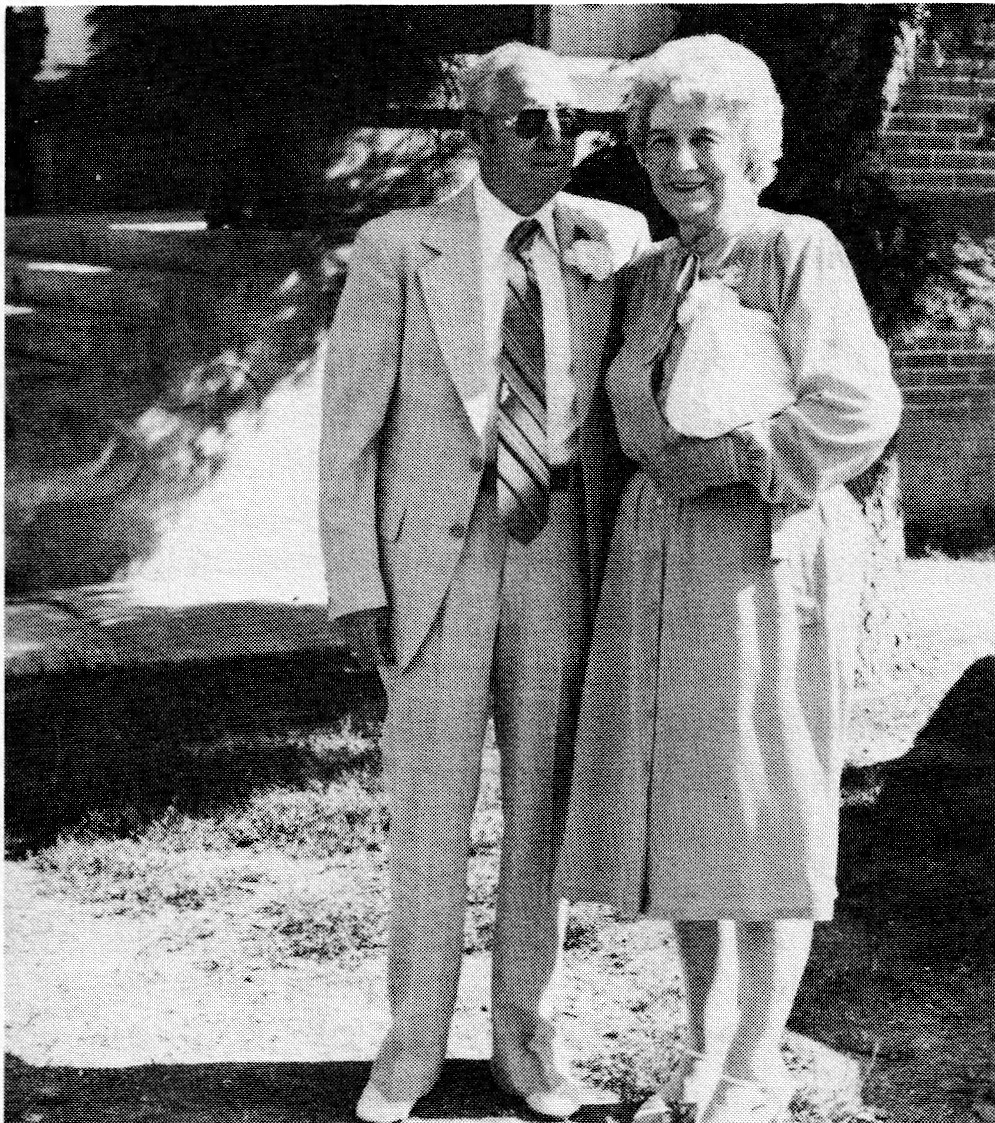
LOUIS AND CLARA (LESSARD) ALAIN
For the most part their story is written down as it was given to me. However, some members of their families, Lessard and Alain, have also contributed.
Louis Alfred Alain was born on March 6, 1909, to Alma and Henri Alain in Ruddell, Saskatchewan. Ruddell is situated on the C.N.R. line about 22 miles southeast of North Battleford. In the February 1907 issue of the newly published local newspaper, The Ruddell News, Ruddell was described as part of the "vast prairie with fertile soil lying along the great North Saskatchewan River with here and there an occasional bluff." It was here that Louis' father brought his bride in 1907 and here on their farm that Louis began his days.
It was his father's practice to go to Delmas for supplies following the spring breakup. Henri would register Louis' birth at this time. Whether the spring was exceedingly late or whether other thoughts filled Henri's mind is not known but the registration never took place. Some sixty years later, Alma filled in a parent affidavit testifying to Louis' birth.
Older members of his mother's family recall that, as a youngster, Louis was one of a kind and had a mind of his own as demonstrated in the following incident. Edith Pichette, a cousin who had been hired as a housekeeper, took great pride in having well-washed floors. Now, having just done the floors one day, she had warned Louis, who was pestering to come inside, that he should wait a few minutes until the floor had dried completely. However, to test her he decided to take a chance and walked bravely into the room – only to be met by the one and only Edith who proceeded to take him over her knee. That day Louis met "the Board of Education" -- words that he used when disciplining his own children years later.
While Louis was still a toddler, Henri moved the family to Delmas where he purchased land. Louis attended the small two-room school and was taught by the Sisters. He enjoyed playing football and horseback riding. He remembers, "I learned to ride when I was seven years old. We had free range cattle and it was my job to round them up."
However, Louis' fondness for horses sometimes got him into trouble. His sister, Yvonne, relates:
"He would rather ride horses than attend catechism on Sunday afternoons. He and our cousin, Phillippe (we used to call them the two Apostles), would ride out on the prairies and look for stray horses. They were like two desperadoes galloping with the wind, not a care in the world until old Father Wattell got hold of our dear old, good-natured, Dad and that was the end of their little escapades."

Then there were times when Louis and his older brother, Smokey, got into trouble together. Smokey tells us:
"One fall Dad and a big crew of men were threshing about one-quarter mile from our house. Louis and I wanted to help pitch sheaves but the men wouldn't leave us in the rack. So I told Louis, 'Let's wait till noon and as soon as they are gone for dinner, we'll start the engine.' When Dad had turned around and was far enough away, we started the engine by pulling on the belt. Sure enough it started – putt, putt, putt – away it went! We were both so excited we were jumping up and down. Then we laid out our plan. Each of us would be in a wagon and we would take turns pitching in sheaves. This way we wouldn't plug the belt up."
"Now when Dad reached home, Mother questioned him as to where the boys were. Dad glanced through the window and answered surprised, 'Why they're threshing, those little beggars – they've started the engine!'"
"As soon as we had threshed each of our loads, we stopped the engine and ran proudly towards home where we told everyone what we'd done. Dad just turned to us and said, 'Yes, I know what you've been doing – you've been threshing!' It sure was a good thing everything went well!"
In time the boys grew to be more responsible and were a big help on the farm after school. When Louis was 14, his father taught him how to drive the binder. From this time on he stayed home in the fall to help with harvest.
About this time Louis attended Gravelbourg College for one year with his brother, Smokey. However, the little cowboy soon returned to the farm, his horses and riding. Louis often helped his uncles to break horses as they felt he had a special way with horses. He rode well and one year after the family moved - in either 1928 or '29 - Louis took all firsts in the racing events held at Hudson Bay's Sports Day.
But the day was coming when the horse would be replaced by the car and, on the farms, by the tractor. Henri already had both -- a car and a tractor.
On a fall day in 1921 just after Louis' youngest brother, Paul, was born, his father asked Smokey and Louis if they wished to accompany him to Battleford. And so the three of them set off. Louis tells us about the events that followed:
“After Dad's visit with Mother in the hospital, we left for home. Joe Duvald caught a ride home with us. On the way, the car broke down so the four of us began walking. Dad set quite a pace for he was a good walker. Smokey didn't have much trouble keeping up but it was different for me as I had a bad hip at the time. Joe trailed behind carrying a bottle and occasionally hollering ahead, 'Henri, stop! We'll have a drink!' But Dad was not to be sidetracked for he hoped we would meet up with the evening train known as the Battleford Jet. After walking about eight miles across country, Dad was able to phone Battleford to see if the train had gone by. You can imagine our disappointment when he told us it had left Battleford four hours ago. By this time it was 2:30 a.m. so Dad decided we'd spend the night with a family by the name of Prince. They lived about a half mile from the track. Later that morning we caught the train and returned to Battleford where Dad hired the taxi to take us back to Delmas, but not before making arrangements to have the car towed to a garage.”
Prior to the spring of 1928, Louis and his father went to the White Poplar Settlement where they built a house. The rest of the family moved in April. Henri and Smokey each applied for a homestead. Louis applied for his 160 acres in January 1929. It was the northwest quarter of Section 21 and was 2 miles north of the Siding which was now known as Veillardville.
The next few years were busy ones for Louis. He cleared land, worked at his father's sawmill, and built a road with Smokey north to their farms. Also during these years, Louis returned to Delmas to help with harvest. In the winter of 1932-33 he went to Flin Flon, Manitoba, where he hauled firewood. In 1934 Louis began working as a mechanic for the Hudson Bay Mining and Smelting Company in Flin Flon.
Although Louis was kept busy during these years he still found time for the fairer sex. In Yvonne's words, “Louis met one of the local belles, namely Irene Walton. Of course, what attracted him to her was her beautiful horse, Sandy. They entered Sandy in a few races; needless to say, Sandy won.” But, in the long run, it was another of the local “belles” who won Louis' heart.
Clara Lessard, at sixteen, was blossoming into a striking young lady with her brown eyes and chestnut brown hair. Up until their brief but meaningful encounter one summer night, Louis had given Clara little notice. Perhaps it had something to do with the difference in their ages.
Clara's family had moved to Veillardville from Delmas the same year as Louis' family had come. Born in Meota on November 24, 1919, to Rachel and Joe Lessard, Clara Edith was their fourth child. Her earliest recollections are of the carefree times she spent running and playing on their farm in the Meota District which bordered Delmas on the north.
However, these pleasant memories are shadowed with the tragic loss of her father and oldest brother, George, when she was four and a half years old. She shares some of the events of that spring day in 1924:
“I remember Martin, Gene and I following Mother to the barn to milk the cows 'cause Dad was on the other farm. It was seeding time and George had gone with him. He had helped Dad by driving one team of horses while Dad drove the other. Also, from the other farm, George would be closer to school.”
“When we returned from the barn, there was a car pulling into the yard. It was the Doctor and he asked Mother, 'Where is Joe?' After she told the Doctor that Dad was on the other farm, he wheeled around and left, telling her only that there had been an accident.”
“So then Mother got Joe out of bed; he was just a baby. She got us dressed and we went over to Iversons where Mother phoned Dad's brother, Uncle Fred. She learned that both Dad and George had been badly burned when the wood stove exploded inside the granary where they spent the night. After Dad lit the fire he went out to feed the horses and when he returned, he found the fire had almost gone out. He took what he thought was a coal oil can from outside the door. When he poured some on the fire it exploded. The fall before, Dad had some Indians working for him; they had bought gas and put it in the coal oil can. Of course, Dad had no way of knowing. Although both he and George were badly burned, they managed to walk to Uncle Fred's.
“By the time that Mr. Iverson drove us over to Uncle Fred's, the Doctor had realized the severity of Dad and George's burns and had phoned for the ambulance. Everyone was very quiet and, while most of the adults were in the bedroom where George lay, I sneaked upstairs. I remember wondering why everyone was talking quietly. Dad was in the first room at the top of the stairs. I went in and looked at him; he was just lying there as if he were sleeping. In my little mind I questioned what all the fuss was about.”
“Shortly after, the ambulance came and took Dad and George to the hospital in North Battleford. Dad died the next morning and George about two weeks later. Even after several weeks I did not fully understand what had happened. I remember asking my mother when Dad would be back. She broke down and cried. It was a very difficult time for her.”
Clara continues to tell us about those early years:

“We stayed on the farm that summer. Then, when the garden and crop were harvested, we moved to Delmas into a little house which had just been built for us. Ma rented the farm and we took a cow and a few chickens to town with us. We even raised a pig or two. We sold milk every day 'cause I remember Gene and I used to take the milk at night to a couple of farms. One family had eight or nine kids and we used to take them a couple pails of milk each evening. I don't remember how much money Ma got -- it couldn't have been very much, but things weren't so high so even twenty cents a day would buy enough flour to bake for the whole family. So, with Ma's rent from the farm and the bit of income we made in Delmas, we managed.”
“Then Ma married again, this time to Louis Strasser. He had come to Delmas from Cudworth -- it may have been in the Cudworth area that Louis had first met John Diefenbaker. This was a relationship that was rekindled, even if briefly, some twenty years later. Anyway, Strasser arrived in Delmas with Charlie Paradis. Ma and Strasser were married in the summer of '27 and, in the spring of 1928, we moved to Veillardville.”
“It was not all work -- we used to play a lot and run around. Sometimes we played with Edithe, Berthe and Paul Alain. They had older brothers and sisters but I don't really remember them. Usually, Martin and I played together; one time, though, we got into trouble. We were going to fry bananas so we made a little fire right near some straw. It was somebody's load of straw to bed their cattle for the winter but it was outside. When the straw caught fire, everyone in town came running. I sure got heck and I remember that Ma had been sewing a dress for me at that time. After the fire, the dress was put away and I didn't get it for quite a while.”
“When we left Delmas, I couldn't figure out why we were moving. I was very satisfied with my little life. When we moved to Veillardville we saw a lot of bush -- it was nothing like Delmas. We bought the farm that had belonged to Moodies for a thousand dollars. It was supposed to have four acres broke but I don't really know where it was. Instead of taking the trail or path, we would jump from stump to stump to go to Quinns, our neighbors. The farm was a quarter section with a twenty-four by twenty-four foot log house, and a couple of old barns.”
“That first summer we had a sow with little pigs and one morning Ma got everyone up in a hurry. The pigs were swimming! It had rained so heavily that the creek had overflowed. The meadow was covered with water; even the pig house was floating toward the creek. Later, we found we could go rafting -- a great way to have fun!"
"Things were not going smoothly at home with Ma and Strasser. There was a lot of friction; finally, they split up. That winter Ma moved into Hudson Bay: things were really bad. The school was closed in Veillardville as no one had been able to pay their taxes."
"It was about this time that I started working steady for the Eyford family in Hudson Bay. They were one of Ma's customers while we lived on the farm -- buying our farm products and, in the summer when the roads were good, they drove out and picked fresh vegetables as they were ready. Sometimes Mrs. Eyford would ask Ma to let me go back with them. At first, I went more for fun than anything else. Then Mrs. Eyford asked me to go for a weekend, later requesting my help for a week, explaining she needed me to do some housecleaning. It was fun for me 'cause it was such easy work compared to chores on the farm."
"Mr. Eyford worked for the C.N.R. so the family lived in the station house. They had electricity and hot water. There was a well behind the station so, on wash days, you just filled the machine with this hot, soft water. We needed to carry the water out but, on the farm, we had to melt the snow and stoke the fire. Mr. and Mrs. Eyford were very good to me and even wanted to adopt me."
Mr. Eyford recalls Clara and the first years she stayed with them:
"Those were Depression years -- very tough times, even clothing was scarce. The Strasser family was no different; they were going thru bad times like everyone else. Clara was eleven or twelve years old. She was a small girl and very pretty. It was winter time and she was wearing knee length rubber boots. She was a very nice girl -- very thankful for everything. And she was a godsend to us at that time for our boy who was five or six had had an accident -- his eye had been poked out -- so we wanted Clara to keep Glen company. She stayed four or five months and went to school. She was very good to Glen and a very good worker."
It was during these years when Clara was sixteen that a particular incident occurred which would affect her future. The young people often gathered at Veillard's store on mail nights and, one particular night, one of the young ladies, Maria, whom Louis Alain had previously courted, was in the group of girls along with Clara and Edithe. Maria knew that Louis was coming home that night on the train from Flin Flon, so she suggested, "Let's surprise him and all kiss him when he gets off the train."
Following this, Louis found his way to the Strasser home a time or two before returning to Flin Flon to work with his team hauling wood. Undeterred by the distance separating them, the young couple corresponded the best part of a year. Then, in February of 1937, at the request of Louis, Clara travelled to Flin Flon accompanied by her mother. It was at this time that Louis proposed to Clara. He presented her with a diamond at his sister Yvonne's home and that evening they made plans to be married on April 12.
Mrs. Strasser and her daughter returned home -- there was much to be done in the coming weeks. During this time, Frances Fransky helped Rachel for, as she said, "Clara's head was in the clouds." Mrs. Rose Burgess of Hudson Bay sewed Clara's wedding dress, which was left at the Eyford home.
So, the evening before her special day, Clara went to Hudson Bay and stayed one more night with this good family. In the morning she dressed in her long gown of white satin and rode to church with Eyfords. Her dress featured a softly rounded neckline and the skirt was pleated. A long-sleeved jacket with lapels and a peplum was worn over this. Her headpiece consisted of a narrow lace bandeau, fitting closely over her hair. The veil was attached to this in a ruffle which gave added height and then fell softly to the floor.
She carried a bouquet of long-stemmed red roses with lily of the valley tied with a large bow as she walked down the aisle on the arm of her brother, Gene. Bridesmaid, Yvonne Veillard, wore a pale green gown. Rolland, Louis' younger brother, was best man. Father Anciaux performed the ceremony in St. Dominic's. During the singing of "On this day, O Beautiful Mother" by Henri Alain and the Church choir, Clara in the traditional custom removed her crown and placed it before the statue of Our Lady.
Following their marriage, which took place in the morning, the couple along with family and guests went to Marcotte's Hotel for a reception which was a complete surprise to the bride and groom. Wine and cake were served by Mr. and

Mrs. Alcide Marcotte in their living room. It was a very kind gesture on their part for the bridal party and guests had about eight miles to travel to the bride's home for the wedding supper. About half the people travelled in sleighs and the other half with buggies or wagons. There was mud and snow on the roads that spring day and, while the day itself started out sunny, it turned cold and it snowed a bit before the day was over. Before reaching the farm, the bridal party stopped at the Alain home to see Louis' mother who was not well and was in bed. At the farm, chicken, vege-tables and salads were served. And there was the wedding cake -- four or five layers high, it was a fruit cake baked and tastefully decorated by Louis Godin's Bakery in La Pas. Later, with the meal cleared away, everyone journeyed to the hall at Veillardville for the wedding dance at which Albert Bernier, Clara's uncle, played the violin. The bridal couple danced till the train came in which they boarded and were off on their honeymoon. First they went to Winnipeg where they had their wedding photographs taken, then they left for Minnesota, U.S.A., where they vis-ited many of Clara's relatives: Lessards and Ber-niers.
On their return from the States, the new-lyweds stopped briefly in Hudson Bay, then journeyed to Flin Flon where Louis' job as mechanic at the Hudson Bay Mining and Smelt-ing Company awaited him. They lived in a little house Louis had built. Clara describes it:
"It was a one-room shack about a mile out-side Flin Flon. Many of those little houses were called shacks. Ours was a little log building with building paper tacked on the studs inside. It was nice and warm, not like the little house we lived in right after, which we bought from Harry Poitras. For $250, we bought the house and furniture. There were sixteen chairs -- all of a sudden, there were chairs everywhere!"
That spring, when Clara learned that her mother and the rest of the family were planning a move to Ontario, she went home to say good-bye. It was then that Mrs. Strasser suggested that Louis rent her farm for he had always said he'd like to farm. This was quite a decision for the young couple to make: to leave 46¢ an hour -- cash -- to return to a life of uncertainty on the farm. Immediately, Clara sent a letter off to her husband telling him of her mother's proposal. Louis wrote back, "Yes." So Clara hurried back to Manitoba to pack and, one year from the day they were married, Louis and Clara were again returning to Clara's home, this time to make it their home. They only had a bit of land in crop that summer; then along with a couple head of cattle left by Mrs. Strasser, they bought a big sow. That summer, on August 21, 1938, their first child, Marlyne Marie, was born.
During the winter Louis and John Levesque hauled firewood for Louis, then they hauled sawdust for Louis' father. The sawdust was used for grasshopper bait which was badly needed on the prairies. Louis took his father's old car as payment for hauling the sawdust.
On the first of July, 1939, Louis was hailed out. The young couple had nothing to fall back on. Then a frightening incident -- it was after supper and Louis and Clara were going to go for a walk with their little girl. After milking the cow, they stopped to feed the calf and give the rest of the milk to the pig. Clara had set Marlyne down -- she was now sitting up at ten months of age. The old sow, soon to farrow, must have smelled the milk for when Clara turned around she saw the sow sniffing at the little girl's arm. For-tunately, Marlyne was rescued unharmed. This near disaster only further convinced them that the farm held little promise for them at this time.
By the seventeenth of July, they had loaded their few belongings into the old car and were on their way to Ontario. Clara didn't feel too confident about Louis' driving skills in difficult situations so, when they reached Qu'Appelle and saw the deep valley, she was convinced the car would roll backwards. So, with Marlyne in her arms, she walked up the hill -- quite a task considering she was seven months pregnant. Their trip took them through Minnesota, Michigan and back into Canada, finally arriving in Tillsonburg, Ontario, some fifteen miles from London. Shortly after, their second daughter, Maxine Therese, was born.
In Tillsonburg, Louis found work tying and stacking hands of tobacco in a tobacco factory during the summer and, in the fall, he picked sugar beets. He also worked with his brother-in-law, Martin Lessard, building forms and mixing cement for 25¢ an hour.
However, no job was steady so, together, they decided to move to Malartic, Quebec, where Louis' brother Rolland was employed. Louis was hired right away because he could speak English and French. Again he worked in the mines, this time receiving 56¢ an hour. The days were twelve hours with a seven-day work week. This didn't leave the young couple much time for being together. But Clara didn't let it get the best of her. That Christmas she cooked her Christmas dinner and, with it and the two little girls, she went to the mine. Together with Louis in the furnace room, they ate their dinner. They built a small house and remained in Malartic for three years.
In 1942, they moved back to the Veillardville district to farm. The first few winters Louis worked for his dad at his sawmill and, from spring till fall, worked at opening up his farm along with farming it. Then Louis started farming full time, gradually building up the farm until he had 700 acres in production.

Clara was also busy during these years raising their family; by 1959 they had eight children. She sewed most of their clothes. One of the older daughters relates, "I never had a store-bought coat until I was in high school. Mom worked hard especially in the early years, ripping second-hand clothes apart to make over, always striving to see that our clothes fit well, were practical and, above all, were warm in the winter. She taught us how to care for our clothes and to take pride in our appearance."
Summers were busy times for Clara for she always had a large garden and a fair sized raspberry crop, too. She raised chickens each year, always donating three roasted chickens for the church fowl supper come fall. Along with the other Catholic ladies, Clara worked hard for the fowl supper; each donated a large pot of mashed potatoes and another of peas and carrots. As well, each of them took three pies. There was little time for leisure -- only a few snatched moments to read the farm papers: the Western Producer and Country Guide, and the locally-produced weekly, the Hudson Bay Post.

Both Louis and Clara were community-minded citizens, participating and holding office, if asked, on the various boards and service clubs. Louis was active on the School and Church Boards while Clara took an interest in the Community Club, Co-Op Guild, the C.W.L. and St. Anthony's Altar Society.
In November of 1958, while out cutting wood for the winter, Louis slipped and fell on the chain saw. His face was badly cut and required many, many stitches. Fortunately a neighbor, Wilfred Nicholls, was with Louis in the bush at the time so he drove Louis to the hospital in Hudson Bay where Dr. J.B. Silver worked with care to stitch Louis' face. He did a fine job; the scars are almost invisible today. This was just one more of the many times the Alain family was indebted to Dr. Silver for his care and dedication.
It was this same doctor that recommended to Clara, a few years later when Louis suffered carbon monoxide poisoning, that Louis ought to consider other work. In the fall of '62 Louis and Clara visited B.C. They were partial to the Okanagan, feeling that they had endured the cold winters of Saskatchewan long enough. So, in the spring of 1963, they sold their farm and cattle, auctioned off their machinery, shop tools, and some of the household belongings, and moved to Vernon, B.C.
We shall let Clara tell us about both the move and the country in which they chose to begin a new life; she shares with us through her Christmas letter of 1963:
"Easter Monday was a day we'll all long remember as it was actually the last day of real living in our house, that we'd been in since 1943. The next day was very hectic as we had to get everything ready for the sale and then the sale itself. It was a blessing we were so busy that day or we may have called it off!"
"Leaving our relatives and old friends was hard to do, especially after the nice farewell and the beautiful gifts from the whole district and the women's organizations. We have lovely neighbours and friends here already but there is nothing like old friends, of that we all agree I'm sure."
"Anyway we left Bernadette and Rachelle at the convent at Zenon Park to finish the school term and we took Michelle and Joey with us. (Michelle had had her tonsils out and would be out of school for quite a spell anyway.) Our good friend Ray Smith drove our little truck, loaded to the very top, and with us following, we left for B.C. We got to Salmon Arm the next night tired but happy too, to start our new adventure."
"We'll always be grateful to old friends Harry and Gabrielle Poitras who accommodated us while we were looking to get settled."
"We bought a duplex (almost new) which would give us some revenue and then started to look for a small acreage for us to settle on -- we didn't want to live in town. We saw some nice places, some not so nice, and some extra nice, but finally settled for a little (5) acreage which had a little house plus 32 fruit trees -- just 1½ miles from city centre. The house was a little too small for us so we decided to build next to it. We have built ourselves a very comfortable home, and we are quite proud of it, seeing as we did it all ourselves. We rent the little house to a nice young teacher with a wife and 2 cute little boys. We are still doing finishing inside and still have to finish the carport outside and of course there's scads of work in landscaping, etc., waiting for us in the spring but in time it will all be finished and we'll take it a little easier."
"We had oodles of prune plums, pears, and MacIntosh and Delicious apples plus an early variety for summer. I never thought I'd see the day when I'd throw apples in the field but that's what we did. You see, every day there are apples that fall on the ground and we couldn't possibly use them all up. I fed the family apple pie, apple sauce, apple betty, baked apples, etc. till we all had apples coming out of our ears and there were still apples on the lawn -- so we gave away all we could, but still there were apples, so we just had to pick them off the lawn and throw them out in the field (they say they make good fertilizer). It seems such a waste when so many people on the prairies could use them."
"Fruit is really very cheap here. We got lovely cherries for 10 cents a pound, Bartlett pears are $1 a box; so are apples -- even peaches are only $1.50 a box. (I mean the big apple boxes too.) We all ate fruit to our hearts content, believe me."
"Gardens and small fruit grow very well here and they produce too much. We only had 12 tomato plants and we had ripe tomatoes from the 25th of July and are still eating some of the last ones and we ate a lot, 3 meals a day all we wanted and I canned over 20 quarts and gave oodles away besides. We have irrigation so it's nothing to turn the hose on, and with all the sunshine we have -- things just have to grow."
"This is really a beautiful valley and, with all the lakes around, summer is a veritable camper's playground. One of the most beautiful lakes we've ever seen is Kalamalka Lake (means Lake of Many Colours) and it is really true to its name. Driving along its shore overlooking the lake one marvels at all the beautiful colours, from pale blue to dark and on to pink and mauve to yellowish green, etc.; it's really lovely. The beaches are all fine sand and you can wade in a long way. The kids and Louis were after me to get a bathing suit for over a month so I finally broke down and got one. (My old suit and I had parted company long ago -- I got too big and it got too small -- ha ha.) Anyway I spent every chance I had in the water after that and Louis and I both had a lovely tan. When we go to the beach we really relax -- as there are no mosquitoes or sand flies or bull dogs either. I can hardly wait for summer to come again and needless to say the kids thought it was wonderful."
"I worked in the cannery this fall for 6 weeks or so and I really enjoyed it too. The work was something I had never done and moving from job to job proved a real challenge. I even operated a lid-closing machine for 2 weeks and just the fact I met so many ladies and that I can now go downtown and say hello to some of my fellow workers means a lot. Louis hopes to get on there, also, for next spring."
The children still at home, Bernadette, Rachelle, Michelle and Joey liked their new country, climate and home and even adjusted quickly to the urban life style. Clara goes on to tell us about Joey and what he thinks about their B.C. winter:
"Joey is still our little boy -- even tho he'll be 5 in February. He has a trike and so has the neighbours' boy, Brian, and the two are insep-arable. They are together from morn till nite and get along just swell. He still talks about Saskatchewan and when we got the first snow fall on the mountains he was bound we'd go up there and play in the snow. Says 'back home when it snowed there was snow all over'! We're to go up to the Silver Star (ski resort) 12 miles from here next Sunday to let him play in snow. Lawns are still green down here."
It has been said that you can take the farmer off the farm but you can't take the farm out of the farmer. Perhaps this is true, for as Clara relates:
"We miss the farm enough that we bought a cow and calf -- had 7 hens all summer (just killed them off plus 30 others). We also bought half a pig so we're really still farmers at heart. How-ever, the worries of this kind of farming are small and I'm sure Louis' nerves will benefit. T'was a gamble we had to take as the stakes were too high and we're hoping and praying that we all benefit from this move."
Neither was the move to Vernon the last of their moves. They went to Golden, B.C. where
Louis worked as a millwright for one and a half years, later returning to Vernon. They sub-divided their five acres and even had their own road; it was named Alain Road. They continued to buy, renovate and sell homes in addition to the two they built. Yet they felt it was an easier life, for as Louis remarked one day, "It was kind of a slow ease into retirement." Although Louis retired as sixty-four, he and Clara have kept busy for they feel this is the key to a successful and happy retirement.
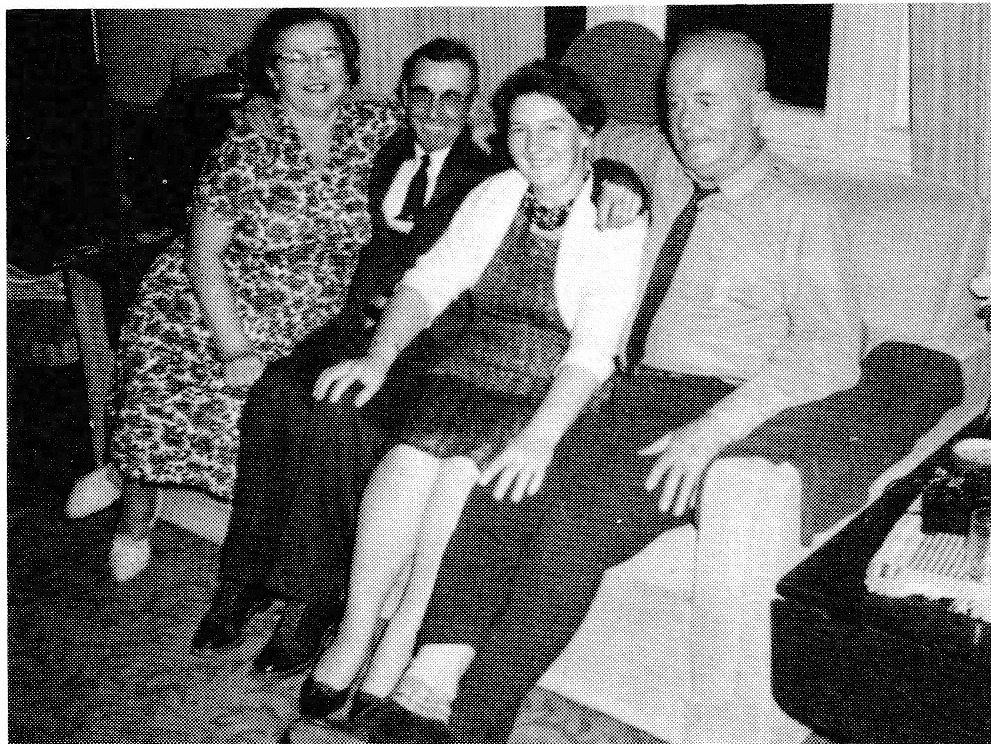
They've travelled much of our country to visit family, friends and numerous cousins. They have seen most of British Columbia and even gone south where they've spent four winters in Ari-zona. For a few years Clara experienced back problems so they decided to make Vernon their home twelve months of the year. In 1980, they sold their property, then moved into Morris Manor where they still live. Louis at 78 spends most of his spare time playing billiards and crib-bage at the Schubert Centre, while Clara at 67 enjoys walking, riding her bicycle, and volun-teers several hours each week at the Centre. The Schubert Centre was constructed in 1983 and is a recreation and social centre for Vernon Seniors. Both Clara and Louis maintain an active interest in and voluntarily contribute part of their leisure hours each week to the various activities held at the Centre. And, as Clara says, "One thing for sure, we're not bored."
Throughout the years, Louis and Clara's lives have been people-centred with family claiming the lion's share of their time and interest -- perhaps this explains why they made 23 trips back to Saskatchewan in the first 21 years following their move to B.C. This is also at the heart of their involvement and interest in their fellow residents at Morris Manor. It really doesn't matter whether someone simply needs a visit or a ride to the clinic, Louis and Clara are ready to oblige and they are just thankful that their own health allows them to do for others less fortunate.
"I have loved people, country-wise and good,
Who tread the simple quiet ways of earth,
Acquainted with the sunrise and the night.
Aware of death .... of tragedy and birth.
People whose hearts are somehow closely knit.
With God's good world and all the joy of it."
Edna Jacques in "Ontario Countryside", taken from The Best of Edna Jacques